 Syncgate
Link scattered knowledge
into a graph
Links database schemas, business policies and glossaries as nodes and edges. Agents follow the relations between nodes to explain how data and policies are connected.
Link scattered knowledge
into a graph
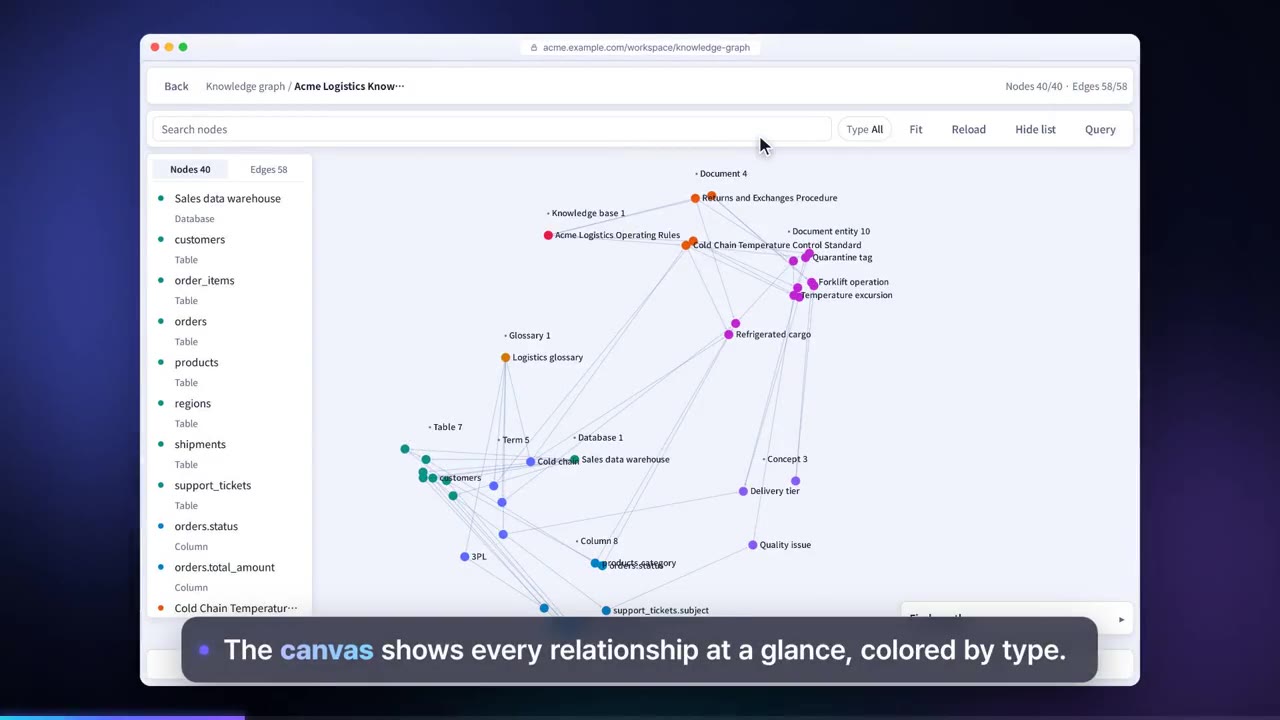
Connect database schemas, operating rules and glossaries as nodes and edges. Agents follow the links to answer with the context between data and rules.
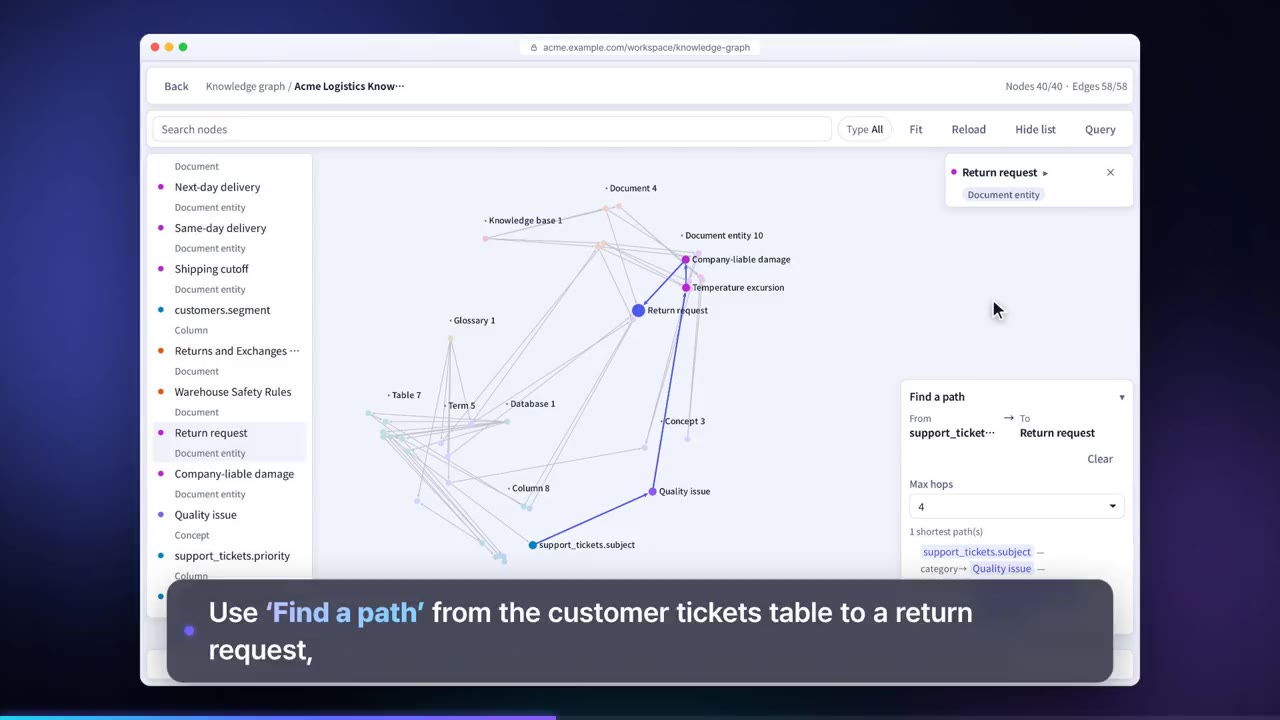
Select two nodes in turn to find the shortest path. Hover over a node to highlight its connections. Sample data from the example company ACME Logistics.
Before and after adoption
Few people know which column in which table relates to which policy.
Tables, columns, concepts, terms and documents are linked, and the path between two nodes can be found.
AI does not answer well when a question takes several steps to work out.
The agent follows edges to find the relations, then answers.
The same entity is registered more than once under different names.
Duplicate nodes are found and merged into one.
Four steps
Connect databases and knowledge bases to build nodes and edges.
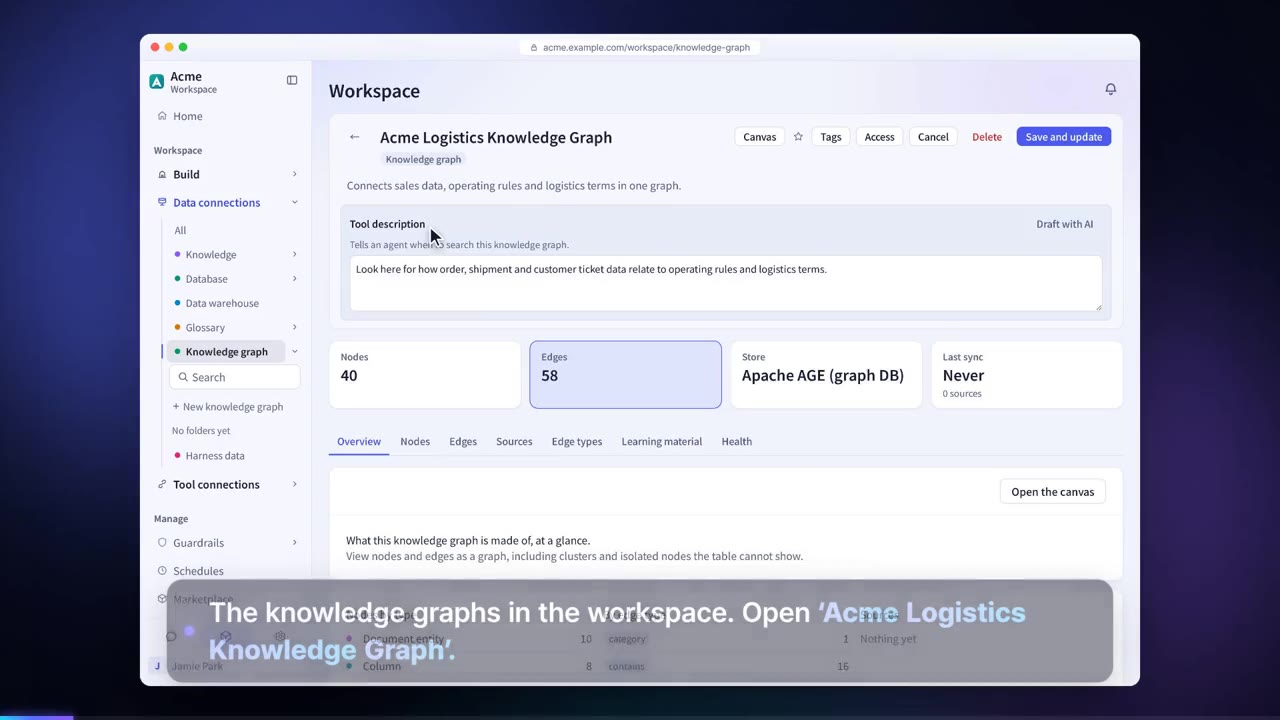
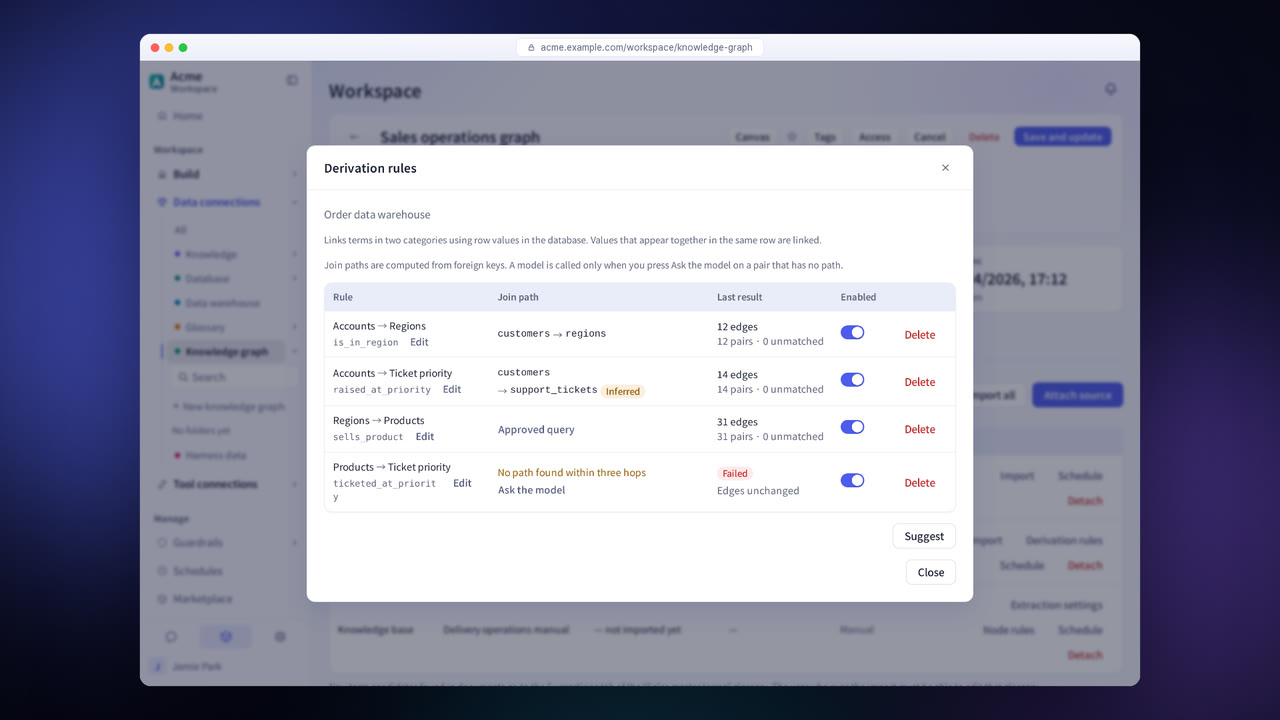
Decide which rows and sentences become nodes and edges, and apply them after approval.
Find the path between two nodes, or run a query to find the nodes that match your conditions.
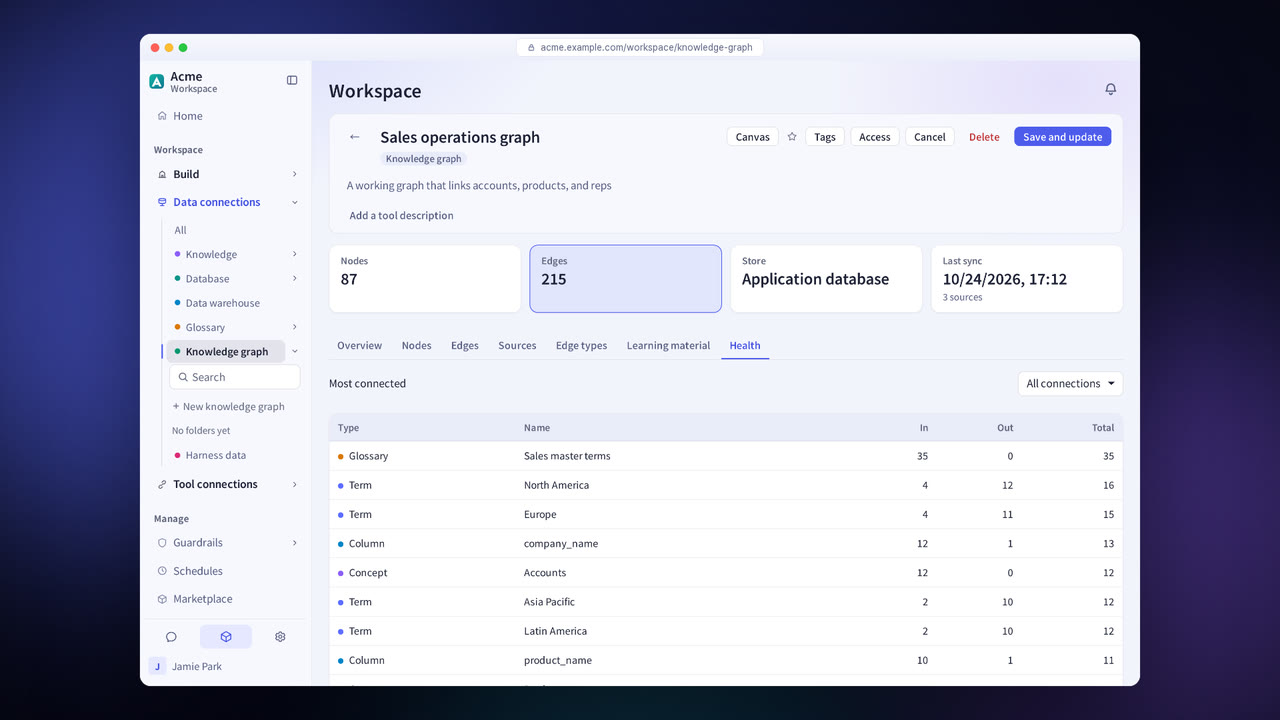
Merge duplicate nodes and check the state of the graph.
Knowledge graph in detail
Node and edge generation
Builds nodes and edges from databases and knowledge bases.
Path finding
Finds the shortest path between two nodes.
Queries
Finds the nodes and relations that match your conditions.
Duplicate merging
Finds nodes that refer to the same entity and merges them.
3 types of graph store
Supports Apache AGE, Neo4j and Amazon Neptune.
Connect to an agent
Connect a knowledge graph to an agent, and the agent follows relations to answer.
Settings each company configures
- Connect the graph store to use.
- Approve the node and edge generation rules.
- Decide how widely to share the graph.
Figures reflect the product as of October 2026.
Related pages
Frequently asked questions about the knowledge graph
Do we need a separate graph database?
No. With Apache AGE, which runs on PostgreSQL, you do not need a separate graph database. Neo4j and Amazon Neptune can also be connected.
Does someone have to build the graph by hand?
No. The system builds the graph from databases and knowledge bases according to rules, and users review the rules and the results.
What kinds of questions does it work well for?
It works well for questions that require following relations across several steps, such as “Which policies does this column relate to?”
See it with
your own documents
In a consultation, we connect a few of your documents so you can check the answer quality for yourself. Send us your questions and our team will get back to you.